
A useful cabinet lock RFQ identifies the requested assembly, drawing revision, quantity and unresolved requirements. Ask each supplier to quote against the same information and to state what is included. That makes a price comparison meaningful before you start comparing commercial terms.
This guide gives purchasing teams a practical enquiry format for industrial cabinet locks. It complements the cabinet lock selection guide: use that guide to define the mechanism, then use this one to make the quotation scope clear.
Identify the model and the drawing revision
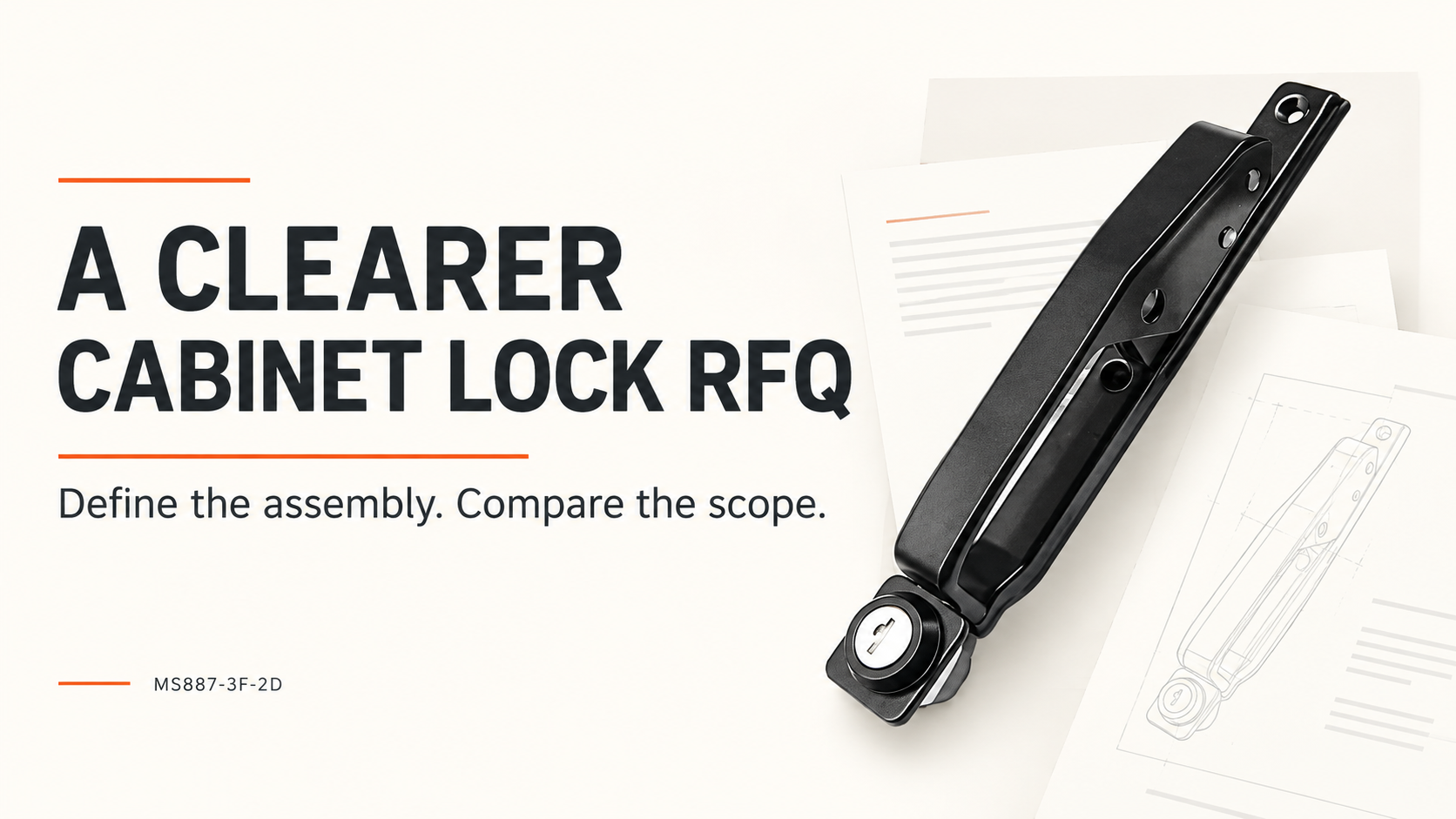
Start with the complete model reference, including suffixes shown in your records. Attach or link the drawing being used and name its revision or file date when available. If you are asking for an alternative, describe the fixed requirements and ask the supplier to identify deviations explicitly.
The INMAX MS887-3F-2D page is a starting point for that model. For other configurations, browse the product catalogue and use Source to locate the related original files. Avoid substituting a similar-looking model when a reference is incomplete; flag the identification question instead.
Define the assembly you expect to receive
“Cabinet lock” can leave the supply boundary unclear. List the operator or lock body and ask which cams, fixing parts, brackets or other components are included. For a rod-control arrangement, list the actuator and the connected components that need a quotation. Mark customer-supplied parts separately.
A useful supplier response names the proposed parts and identifies anything quoted separately. If one offer includes connected hardware and another covers only the actuator, resolve the scope difference before comparing the totals.
State quantities and purchasing stages separately
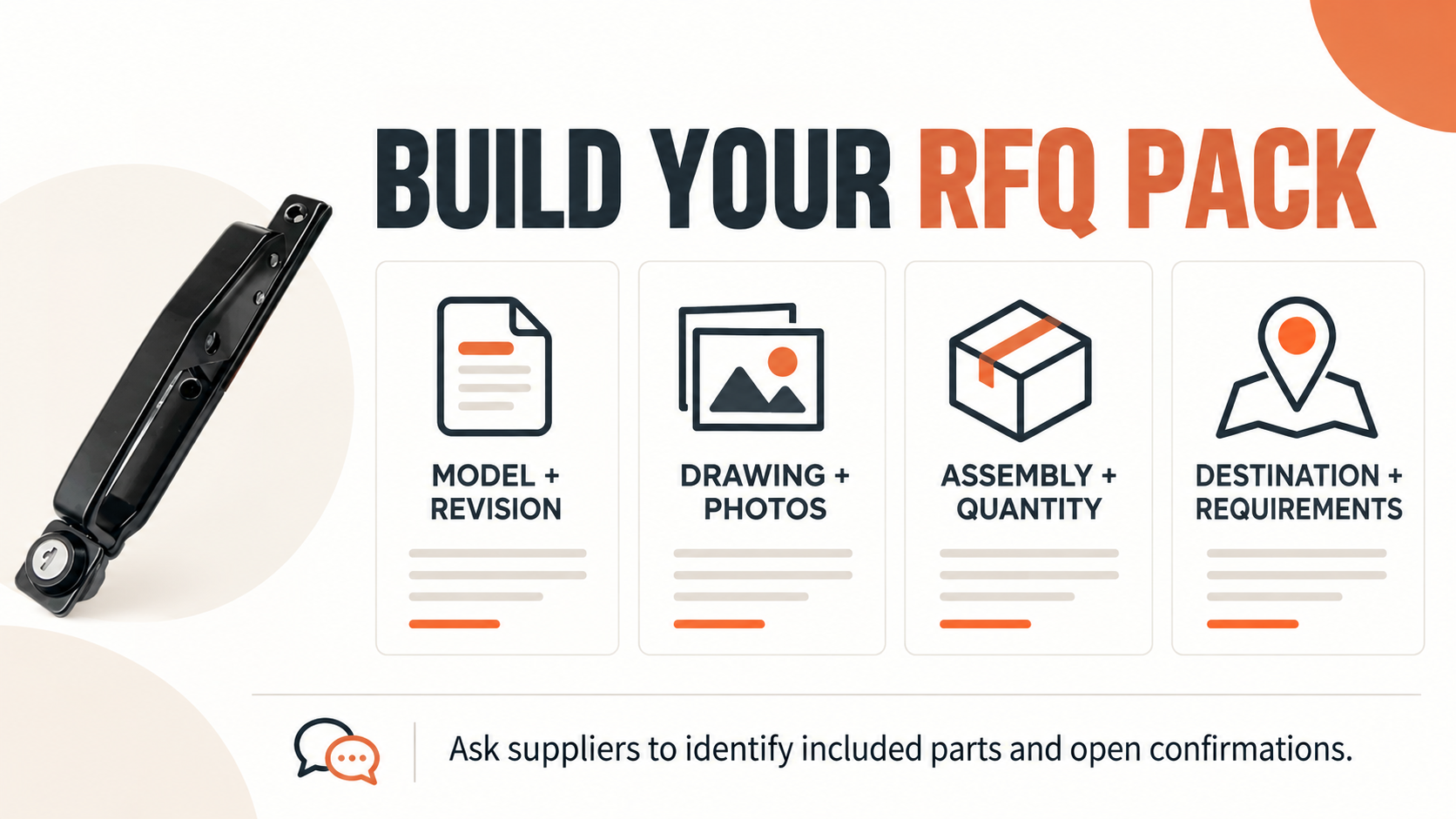
Give the quantity needed for the current purchase. If you also want a sample quotation, list it as a separate line. An annual estimate can provide context, but distinguish it from an order commitment and from the first batch quantity.
Ask the supplier to state the quotation’s quantity basis and any minimum-order or packaging conditions that apply. Request the current lead-time basis and clarify the event from which it is counted. Do not assume that a sample and a production batch share the same terms.
Describe the application without inventing a specification
Include the door or panel drawing, mounting constraints, required access method and known exposure conditions. Where the project has a material, finish or documentation requirement, state it directly. Ask what information is needed to confirm any unresolved requirement.
If the purchase requires evidence, identify the requested document and the configuration it must cover. A general company document and a product-specific report answer different questions. Keep the confirmation open until the supplied evidence matches the requested scope.
A cabinet lock RFQ you can copy
Replace the prompts below with your project information before sending the enquiry. Leave an unknown item labelled “to be confirmed” rather than guessing.
Subject: Cabinet lock quotation request — [model or drawing reference]
Please quote for the cabinet-lock assembly described below and identify any deviations or items requiring confirmation.
- Model/reference and required configuration:
- Drawing filename, revision and units:
- Application and fixed mounting constraints:
- Included parts required; customer-supplied parts:
- Access method and key/tool requirements:
- Sample quantity and first batch quantity:
- Estimated repeat demand, if relevant, stated separately:
- Material, finish and required supporting documents:
- Destination and requested delivery basis:
- Requested timing and open technical questions:
Please state the proposed part/configuration, included and excluded items, quotation quantity basis, currency, applicable commercial terms, validity and lead-time basis.
Compare offers in a scope table
Put each supplier’s stated offer next to your requirement. Use “not stated” for missing information. A blank field is a follow-up question, not evidence that an item is included.
| Comparison field | What to record from each offer | What needs follow-up |
|---|---|---|
| Part and revision | Exact model/configuration and referenced drawing | Suffix changes or unlisted deviations |
| Supply scope | Included parts, separate lines and exclusions | Missing cams, fixings or connected hardware |
| Quantity basis | Sample, batch and any stated conditions | Whether the quoted price applies to your order |
| Documents | Files offered and the product scope covered | Evidence still needed for the project |
| Commercial basis | Currency, delivery basis, validity and stated charges | Costs or responsibilities left unspecified |
| Timing | Lead time and its stated starting event | Unconfirmed dependencies or dates |
Return scope questions to the supplier before making the purchasing decision. If a drawing changes during the discussion, issue the revision to everyone still quoting and request confirmation of its effect on the offer.
Close the open items before purchase approval
Keep the accepted drawing, part list, supplier confirmations and quotation together. Name who will approve dimensional fit and any sample check within your own process. A quotation alone should not be treated as approval of an unresolved installation requirement.
For a replacement project, include photographs of the existing assembly and say which components must remain. For a new enclosure, identify the design constraints still open so the supplier can distinguish a fixed requirement from a possible option.
Send the pack to INMAX
Request an INMAX quotation with your model or drawing, quantity, destination and application requirements. Put the unresolved questions in the message so they can be addressed alongside the price and supply scope. Available configurations and commercial terms need confirmation for the actual enquiry.
Prepared by INMAX as a purchasing workflow using its public catalogue and Source resources. The enquiry format is an editorial template; it makes no price, MOQ, availability or response-time commitment.