
Industrial cabinet lock selection starts with the door’s closing task, access method and mounting geometry. Decide how the door must engage the frame, who will open it, and which dimensions the hardware must fit. Then compare models within a suitable product family. A similar-looking handle or matching front cutout is only part of that decision.
This guide is for engineers and procurement teams choosing mechanical hardware for equipment cabinets and enclosures. It provides a way to shortlist options and identify what still needs confirmation on the model drawing.
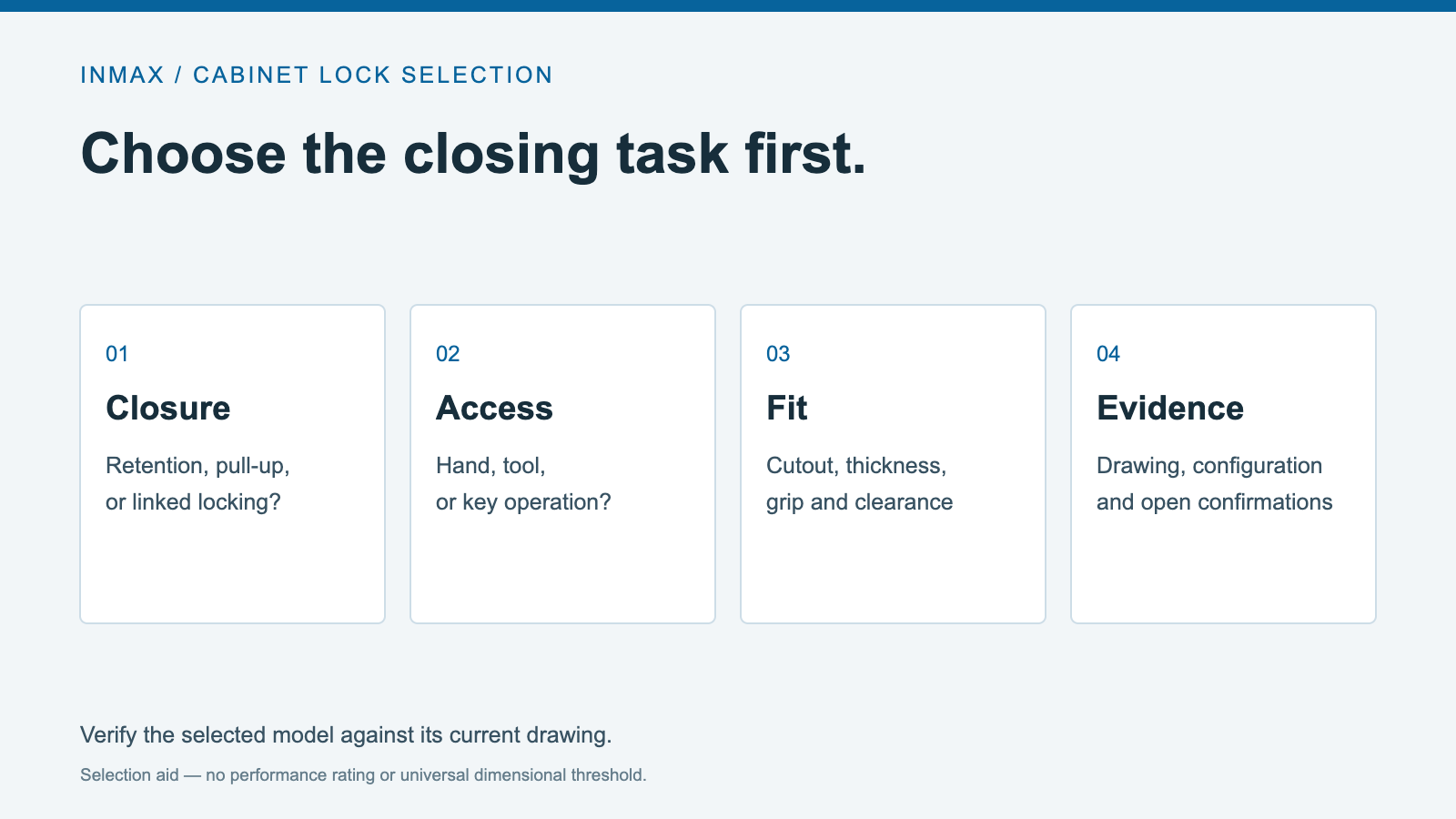
Work through the requirements before choosing a model. The diagram is a selection aid, not a product-performance rating.
How to choose an industrial cabinet lock
Write a short requirement for the door before opening a catalogue. For example: “A service panel that needs tool access, limited space behind the door and a defined frame engagement.” This is an illustrative requirement, not a tested installation or a recommendation for a particular model.
Separate requirements that are fixed from those that remain open. An existing cutout may be fixed during a replacement project. A new enclosure design may allow a different cutout, but still have a restricted opening envelope. Mark an unknown dimension as something to measure or confirm; do not select a convenient value to finish the specification.
Key, tool and hand operation are separate access choices. Southco’s latch selection considerations evaluate them alongside compression and mounting.
Industrial cabinet lock types describe different things
Catalogue names can describe an operator, a mounting style or a closing mechanism. Keep those descriptions separate when comparing parts. A flush handle describes the external arrangement; it does not, by itself, tell you how the mechanism engages the frame.
The INMAX catalogue groups locking hardware into the families below. Use these as browsing routes, then examine the drawing and configuration of the individual model.
| INMAX family | Starting point for your enquiry | What to verify on the model |
|---|---|---|
| Flush locks | A low external profile or recessed operating arrangement | Cutout, handle movement, rear clearance and closure action |
| Handle locks | Handle-operated cabinet access | Operating envelope, fixing, actuator movement and connected hardware |
| Cylinder locks | A compact body/operator arrangement | Body dimensions, cam configuration, rotation and access option |
| Rod control locks | A linked locking arrangement | Actuator, rod connection, guides, keepers and engagement positions |
| Panel locks | Panel-mounted locking hardware | Mounting method, panel preparation and the actual engagement mechanism |
These are INMAX catalogue categories, rather than an exhaustive classification of every industrial latch. They also leave questions that the family name cannot answer: the supplied cam, permitted mounting range, direction of operation and any application-specific performance evidence.
Cam lock vs compression latch
For enclosure lock selection, identify the movement needed at the frame: retention or pull-up. Southco notes that compression can come from a ramped cam or an internal mechanism. A simple “cam versus compression” label therefore cannot settle the configuration.
If gasket compression is part of the requirement, ask how the proposed assembly produces and adjusts it. Confirm the specified arrangement rather than assuming that a handle style or a tight-feeling door proves the result.
Single-point or multi-point locking?
Southco lists door span, gasket compression and access resistance as considerations for single-point or multi-point latching. Its selection criteria do not give a universal cabinet-height threshold.
For single-point versus multi-point locking, review the door, frame and intended engagement locations together. A rod-system enquiry should identify the actuator and connected parts, rather than request a handle alone. Ask the supplier to confirm which components belong to the proposed configuration and which must be specified separately.
Check the complete installation geometry
Panel thickness and grip length need separate checks. Southco defines grip between the latch mounting surface and its frame contact when closed; thickness refers to the mounting panel.
Use the drawing’s own datum surfaces and terminology when recording measurements:
- Panel cutout: Record the complete shape, dimensions and any orientation features. Check the fixing method as well as the opening.
- Panel thickness: Include the mounting stack shown by the design, such as a washer or bracket, where applicable.
- Grip and frame position: Identify the surfaces between which the dimension is measured.
- Cam geometry: Check the supplied cam’s length, offset, engagement and travel against the frame.
- Operating direction: Confirm the required rotation and the open and closed positions on the chosen configuration.
Southco treats external protrusion and internal clearance separately. Flush mounting addresses the outside profile; check the rear envelope independently.
For a replacement, record the existing installation before removing the hardware. A photo can help identify an arrangement, but it should accompany dimensions and a model reference. Ask INMAX to confirm the current drawing before committing to the replacement.
Define access and key management separately
Specify who needs access and how the cabinet is normally serviced. The requirement may call for a hand operator, a particular tool interface or a key arrangement. Record the required option instead of assuming it from a product photograph.
Keyed alike and master keyed are different arrangements. In Southco’s PK Key-Choice documentation, keyed-alike cores share a key code; master-keyed arrangements can include different key codes within a master-key system.
Use that distinction when writing the requirement, then confirm what is available for the INMAX model under consideration. This guide does not establish that every model supports either arrangement. Include key removal position or other operating restrictions if they matter to the application.
Turn environment requirements into evidence requests
Describe the exposure before asking for a material or finish: installation location, moisture, cleaning agents, temperature conditions and any vibration requirement. Avoid replacing that description with a broad label such as “outdoor grade.”
For each consequential requirement, identify what evidence will settle the decision. That might be a material specification, a configuration drawing or a relevant test report. Check which exact part or assembly the evidence covers and under which conditions. A report for a different configuration should remain a separate reference.
Where sealing matters, record the gasket arrangement and the closure requirement together. Keep the required enclosure protection target visible in the project specification, but do not infer a tested rating from a catalogue family or product photograph.
This is a mechanical-selection guide. It does not establish an enclosure’s electrical-safety, security or environmental certification, or prescribe how to work on electrical equipment.
Complete a buyer’s selection worksheet
Use a worksheet to separate what is known from what the supplier must confirm. The example prompts below are questions to resolve, not default specifications.
| Item | Information to record | Confirmation still needed |
|---|---|---|
| Door and frame | Drawing or application description | Relevant revision and engagement surfaces |
| Closing task | Retention, pull-up or linked locking requirement | Proposed mechanism and connected parts |
| Installation fit | Cutout, mounting stack, grip and clearance | Compatibility with the selected configuration |
| Access | Hand, tool or key requirement | Operator and available key arrangement |
| Environment | Actual exposure and project requirements | Applicable material, finish and supporting evidence |
| Purchase scope | Model reference, configuration and quantity | Included parts, sample scope and quotation basis |
When comparing quotations, check whether each covers the same assembly. Ask about cams, rods, guides, keepers, fixing parts and spares where relevant. Include any proposed panel preparation or configuration work in the discussion. The guide provides no current prices, minimum order quantities or delivery commitments.
A useful shortlist ends with a compatible configuration and a clear list of open confirmations. If the drawing or evidence is missing, keep that decision open rather than treating the catalogue image as approval.
Match the requirement to an INMAX model
Browse the INMAX product catalogue using the family that fits the required operating arrangement. Then send your cabinet-lock requirements with the model reference, relevant drawing and the specific points that need confirmation.
INMAX’s contact team can receive the enquiry. Confirm the proposed configuration and destination-country supply before ordering; this article makes no worldwide availability or response-time promise.
Published by INMAX, a supplier of cabinet-lock hardware. This guide draws on public technical references and catalogue information; it is not a hands-on comparative test.