
Your cabinet drawing calls for IP65, but the lock on the parts list says IP54. Before ordering a replacement, check the protection listed for the exact model and the test evidence for the complete door. The IP54 vs IP65 decision affects both dust and water exposure. Whether the new lock fits the existing cutout is a separate question, even when the two handles look alike.
What changes between IP54, IP55 and IP65?
Read the digits separately. The first describes protection against access and solid foreign objects, including dust. The second describes protection against water. For the three ratings below, the practical differences are dust ingress, splashing water and water jets. The classification applies under the specified test conditions. See the scope of IEC 60529 and Intertek’s guide to the IP test levels.
| Rating | Dust | Water |
|---|---|---|
| IP54 | Dust-protected | Splashing water |
| IP55 | Dust-protected | Water jets |
| IP65 | Dust-tight | Water jets |
For IP54 vs IP55, the dust classification stays the same and the water test changes. For IP55 vs IP65, both have water digit 5. Choose between them by checking whether the enclosure specification calls for dust-tight construction.
Which INMAX enclosure locks list these ratings?
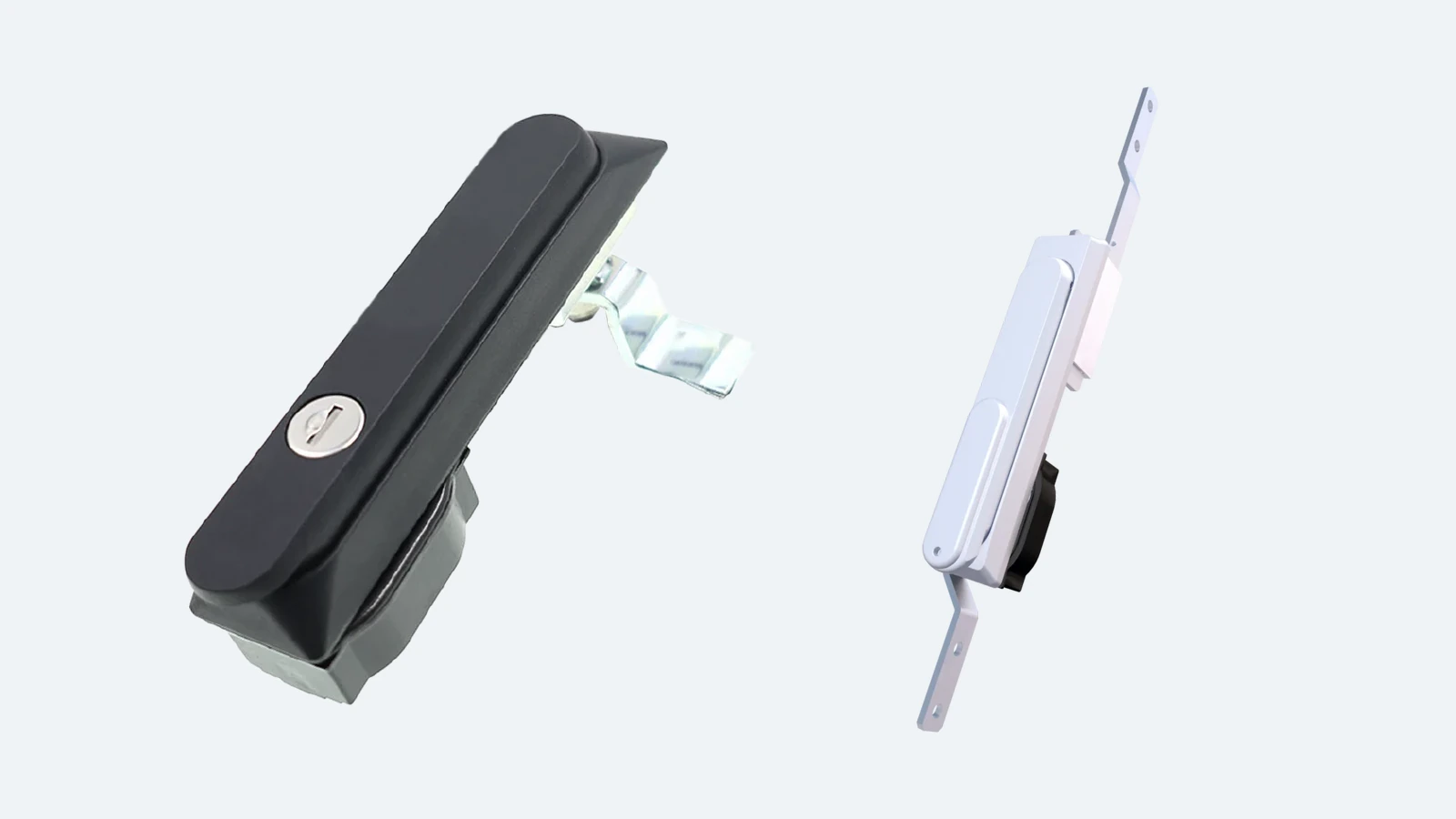
Keep the full model suffix on the bill of materials. The two MS840 rod control locks belong to the same series and carry different published ratings. A buyer who needs a recessed handle can also shortlist an IP65 flush lock.
| Model and mechanism | Published rating | What to review |
|---|---|---|
| MS840-2C-4D rod control lock | IP54 | Two panel openings and the mounting stack. Cutout drawing |
| MS999-6-Y rod control lock | IP55 | Published panel range of 1–2.5 mm and the specified coating. Installation drawing |
| MS840-16-F rod control lock | IP65 | Published panel range of 1.5–4 mm and clearance for the rods. Rod and cutout drawing |
| MS712-Q2-3D flush lock | IP65 | Recessed handle layout and the space available behind the door. Flush lock drawing |
Will the higher-rated lock fit the same door?
The two MS840 cutout drawings both show a nominal opening width of 25 mm. Measure the heights and relative positions of both openings from a common reference edge. Then check the thickness of the finished panel, the rod connections and the space available through the operating stroke. For a replacement, record the existing installation before taking the lock off the door. The cabinet lock replacement measurement checklist gives the views to capture.
For example, a 2 mm panel falls within the published thickness range of the MS840-16-F. A second panel with the same thickness and a different cutout can still need a different lock. Include a dimensioned front view and a section through the mounting face so the supplier can check both.
How INMAX machines, finishes and checks enclosure locks
In our Suzhou workshop, our machining equipment includes an ST-20Y lathe and four 850E CNC machines. The factory also has dedicated lock assembly workstations and coordinate measuring equipment for checking component dimensions. If the position of a linkage is critical to your door, mark the reference face and dimension on your drawing. We can then discuss exactly which feature you want measured on the sample. See our machining, assembly and dimensional inspection facilities.
Our product records also specify how the surface is finished. The MS999-6-Y calls for electrophoretic coating and paint with a nano-matt finish. The MS840-16-F pairs a zinc alloy handle with an aluminium alloy housing and specifies a painted nano-matt finish. An order that says only “matt handle” leaves the material and finishing process open. Record the model suffix and agreed finish alongside the approved sample so the next batch can be ordered to the same specification.
What to put on the enquiry drawing
- Enclosure requirement. State the target IP rating and describe the dust and water exposure expected in service.
- Door preparation. Give the cutout, panel thickness, reference faces and drawing revision. Mark any features already fixed on an existing cabinet.
- Lock and seal. Name the lock model and finish, show the gasket position and identify the contact points. For a linked system, include the rods, guides and keepers in the drawing.
- Acceptance evidence. Identify the dimensions to verify on a sample and ask which test record covers the intended enclosure, door, gasket and installed hardware.
Have a model in mind? Request a quote from INMAX and include the target rating, model and drawing revision in your message. If the door needs several locking points, our guide to single- and three-point flush locks shows what to mark on the rear view.
Buyer questions about IP-rated enclosure locks
Can an IP65 lock establish the rating of a finished cabinet?
The cabinet needs evidence for its assembled configuration. Ask which door, cutout, gasket and hardware the enclosure test covered, then compare that record with the drawing revision on your order.
Which flush lock can I shortlist for an IP65 project?
The INMAX MS712-Q2-3D lists IP65 and uses an aluminium alloy housing with a zinc alloy handle. Check the cutout and handle clearance on its drawing before requesting a sample.
What if my panel is 1.2 mm thick and I want the MS840-16-F?
The published product range starts at 1.5 mm. Give INMAX your actual panel thickness and drawing revision before ordering so the mounting arrangement or another model can be reviewed for your door.
Can I use an IP rating to choose a corrosion-resistant finish?
Specify corrosion resistance separately. For example, the MS840-2C-4D lists IP54 and reports a salt-spray result in its product record. For a coastal or corrosive environment, give the supplier the coating requirement, exposure and test criteria for your project.