
A flush lock keeps the handle close to the face of an industrial cabinet. To choose the mechanism behind it, start with a rear view of the closed door. Mark where the frame should hold the door shut. A single center cam can suit a small, rigid access cover. If a tall door needs to be held at the top, middle and bottom, specify three-point latching and ask for the complete linkage.
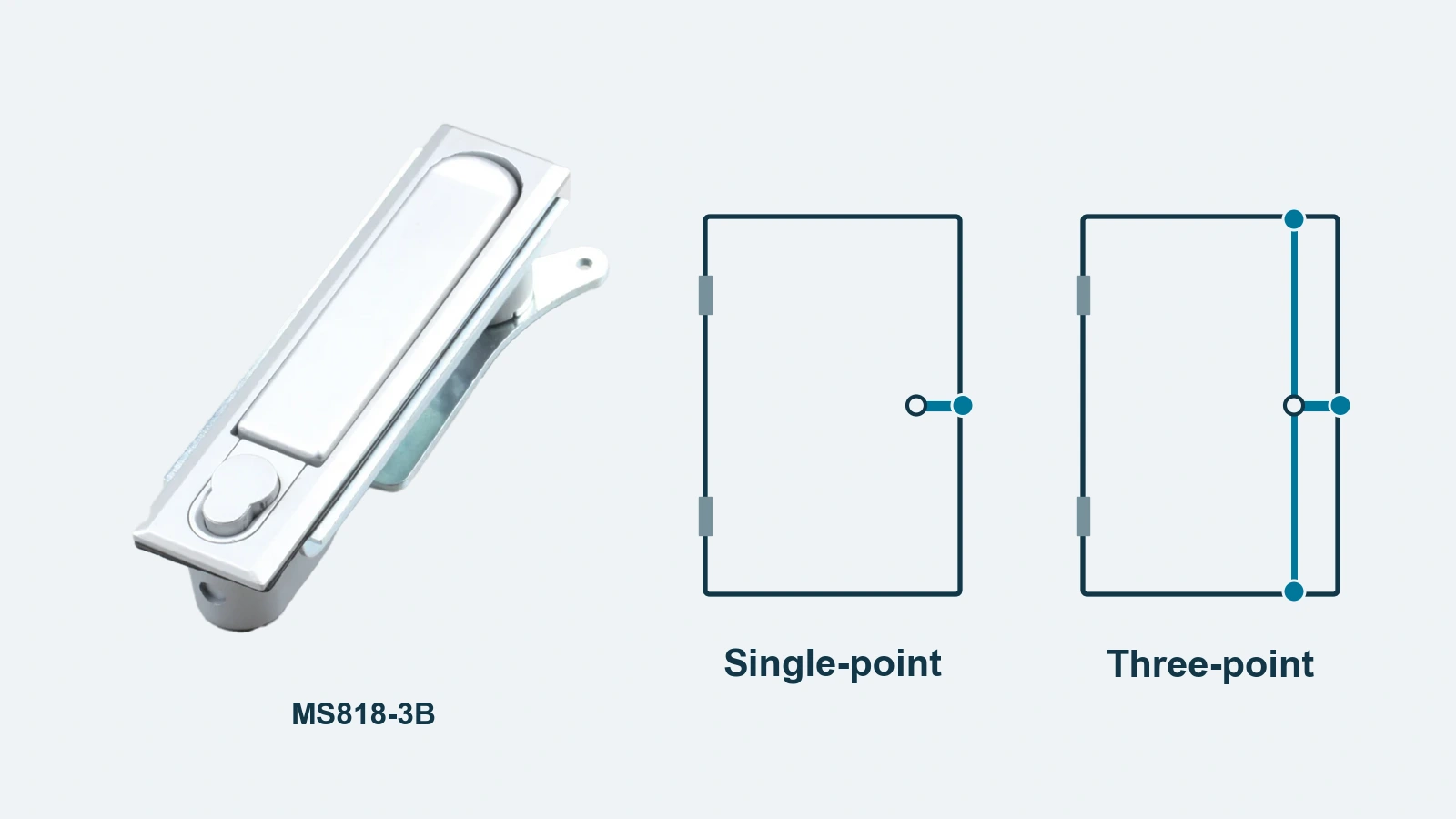
Where does the door need to be held?
For a small service cover, close a sample door against its stops and engage the center cam. Check both free corners. If the door seats evenly and the cam clears the frame when released, a single-point latch keeps the parts list short. Record the distance from the lock’s mounting face to the surface the cam catches. Door thickness alone leaves that dimension open.
On a taller cabinet, the handle can feel tight while an upper corner still stands clear of the frame. Check hinge alignment and the frame for twist first. If the door design calls for restraint at both ends, a three-point cabinet lock lets one handle operate a center cam and two remote latching points. Mark a frame contact for each end and check where the rods can run past stiffeners or equipment.
Two INMAX flush locks with a choice of cams
The MS818 flush lock and the MS818-3B flush lock both offer single- or three-point locking by changing the cam. They list the same K040 key reference but different standard cams. These are the identifiers to put beside the model on a purchase drawing.
| Model and drawing | Listed lock head | Listed standard cam |
|---|---|---|
| MS818 drawing | TC04-1 | S1C72Y00002 |
| MS818-3B drawing | TC04-2 | S3C72Y00002 |
Ask which cam the supplier proposes for your layout and which parts come with it. For three-point latching, a comparable quotation identifies the upper and lower rods, guides, frame keepers and fixings. A price against the handle model alone leaves the scope of the assembly open.
Flush lock sample record for each latching point
With the sample on the door, have one person operate the handle while another observes the keepers. A single-point latch needs the centre check. For three-point latching, record each rod end separately.
| Where to look | With the handle latched | As the handle releases |
|---|---|---|
| Centre cam | Mark where the cam overlaps the frame keeper. | Check that the cam clears the lip before the door starts to swing. |
| Upper rod | Record where the rod meets its keeper and whether the upper corner sits against its stop. | Watch the tip withdraw clear of the keeper. |
| Lower rod | Mark its contact independently, particularly when the handle sits above or below the door centre. | Watch for a tip that still catches after the upper rod has cleared. |
What to mark on the cabinet drawing
- Show the door and frame together. Mark the hinge side, handle centerline and all proposed frame contacts on a rear view. Include the finished panel thickness and an enlarged section through the center cam and keeper.
- Dimension the upper and lower runs separately. Measure from the handle centerline to each intended engagement point. An off-center handle can require different rod lengths. Include the sideways offset if a folded frame return places a keeper out of line with the rod. Ask the supplier to return a drawing that shows the rod length and offset for each end.
- Check a complete opening cycle. With the proposed hardware fitted to a sample door, check that each point engages when closed and clears its keeper before the door swings. For a flush mount latch beside another panel, also check the space for the operator’s hand using the flush cabinet lock clearance guide.
For a quotation, give INMAX the model or door cutout, the number of latching points and the quantity of complete doors. Identify any rods or keepers your own shop will supply. You can include those details in the INMAX quotation form.
Buyer questions about flush locks
Can I convert an existing single-point flush lock to three points?
The MS818 and MS818-3B offer both arrangements. Identify the exact model and cam first. For a retrofit, compare the existing cutout with the model drawing, then check room for the rods and mounts and locate both end keepers on the frame.
Does every tall cabinet door need a three-point lock?
Door stiffness, frame alignment and the required points of restraint determine the choice. A useful sample check is to latch the center, then check how the two free corners sit against their stops. Give the supplier those observations together with the door dimensions.
Does a three-point latch give my cabinet an IP rating?
An IP code describes protection provided by the enclosure. If your specification calls for an IP rating, ask for evidence covering the assembled door, lock, gasket and installation. IEC 60529 defines the enclosure IP classification.
Which details help match a replacement if the key says K040?
Photograph the handle and the back of the lock, look for the model and cam identifiers, and note which points engage when the handle moves. Both models in the table list K040. The head and cam references help distinguish the assemblies.