
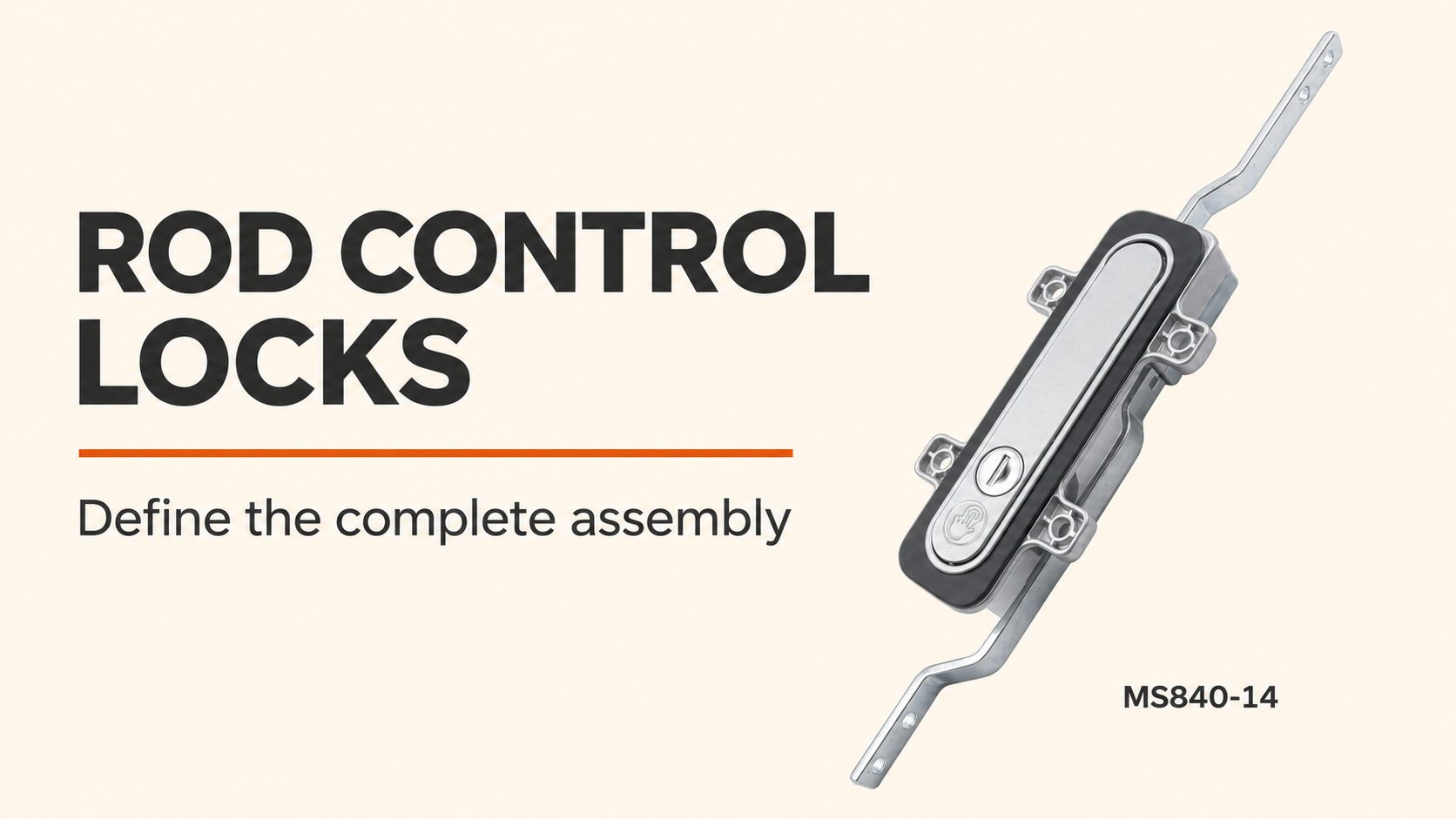
A rod control lock enquiry should describe the complete locking arrangement: the actuator, the rods and their connections, the guides, the frame-side parts and the fixing hardware. A handle model on its own can leave several of those items outside the quotation. Start with a marked enclosure drawing and a parts list, then ask the supplier to identify the proposed assembly.
This checklist is for buyers preparing a rod-control system enquiry. It helps define supply scope and open questions; it does not determine the number of locking points or approve a mechanism for a door.
Begin with the door layout, not a handle photograph
Send a drawing that identifies the door, its orientation, the frame and the proposed engagement locations. Mark which views show the open and closed conditions. If the drawing has not yet defined a locking point, label it as a question for review rather than adding one to make the enquiry look complete.
For replacement work, add photographs of both sides of the existing door and name the parts that must remain. For a new enclosure, distinguish fixed mounting features from details that can still change. The supplier then has a clear basis for identifying what needs confirmation.
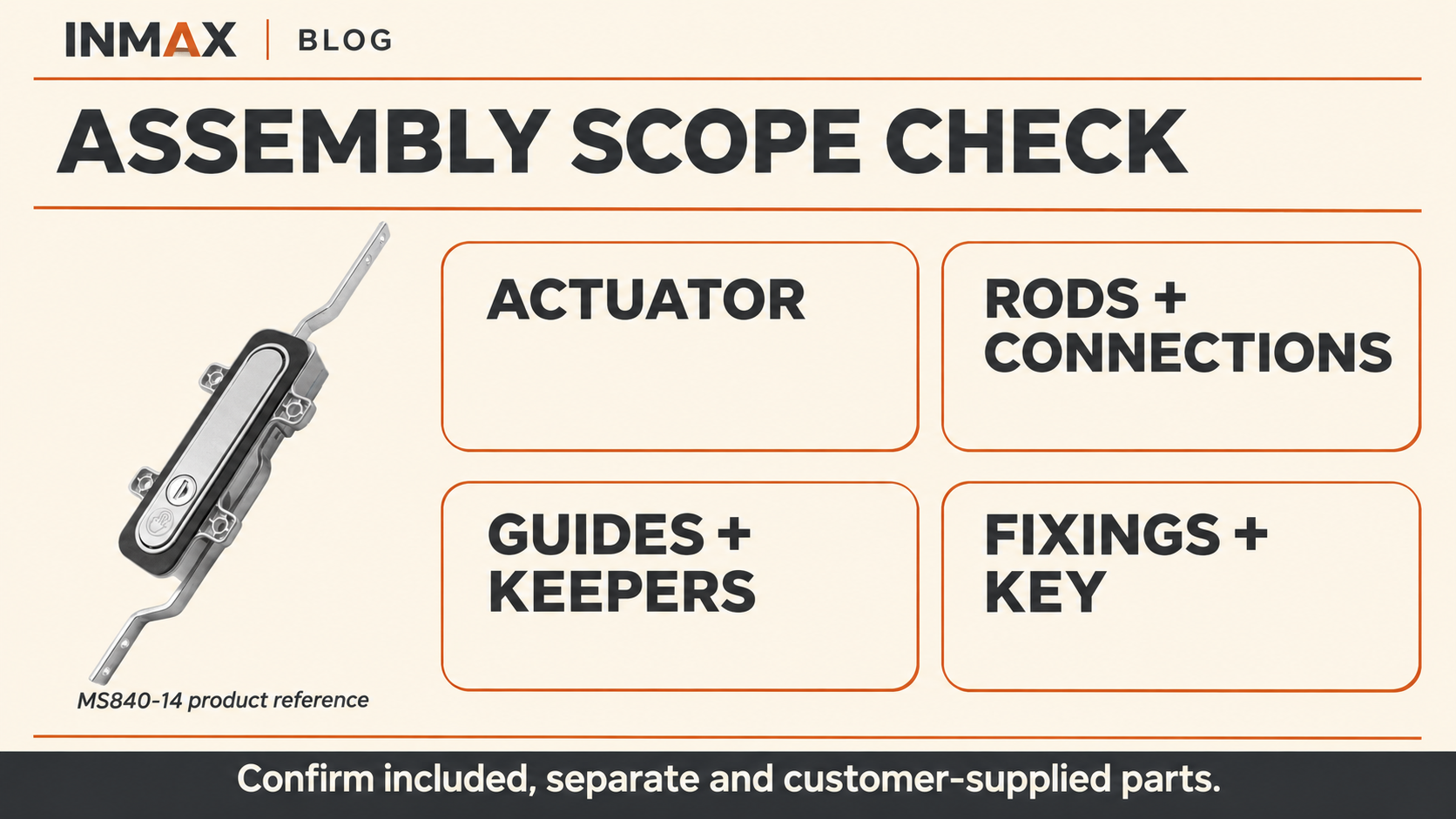
Use a parts list to separate five supply questions
The following groups are prompts for an enquiry, not a universal bill of materials. Some arrangements combine functions in one part, while others require separate components. Ask the supplier to confirm how the proposed configuration is supplied.
| Part group | Record in the enquiry | Ask the supplier to identify |
|---|---|---|
| Actuator and lock | Full model reference, access method and drawing revision | Exact actuator or drive assembly offered |
| Rods and connections | Layout, existing references and any parts to be retained | Proposed rods, connectors and preparation requirements |
| Guides | Available mounting positions and retained guide references | Compatible guides and their supply scope |
| Frame-side parts | Proposed engagement locations and existing frame hardware | Keepers, catches or other mating components in the offer |
| Fixings and access items | Required fixing scope and key or tool requirements | Included fixings, keys and separately quoted items |
The distinction matters in real catalogues. EMKA lists rod controls, rods and guides and catches separately. Those references help explain the component groups; they do not establish compatibility with INMAX products.
Read the INMAX model record at its stated scope
INMAX’s MS840-14 product page identifies a rod control lock, describes its handle operation and lists original technical files. It also gives a cam part number and a supplied-key reference. Use those entries to ask precise questions about the proposed order rather than assuming that every part in a larger door system is included.
Open the MS840-14 original drawings alongside the product record. Ask INMAX to confirm the current drawing and the exact configuration being quoted. If an alternative from the rod control lock range is proposed, request its own drawing and parts list.
Make connections and retained parts explicit
A rod, guide or frame-side part already fitted to the cabinet is useful identification evidence. Record its reference and relevant drawing details, and ask whether it can remain with the proposed actuator. Similar appearance is not confirmation that the interface matches.
For every retained part, put one question in the comparison: “Can this identified component remain in the proposed assembly?” Ask for a written answer that names the part and configuration. If the answer is still open, keep it open on the purchase record.
When new rods or connections are offered, ask the supplier to state any cutting, drilling, adjustment or other preparation required by that specific proposal. Assign responsibility for the work before ordering. This checklist does not prescribe those operations or provide installation dimensions.
Separate assembly quantity from component quantity
State how many doors or assemblies you are buying for, then give the number of each requested component. For a sample enquiry, identify whether you need one complete proposed set or only the actuator. List spare parts separately so they do not disappear into an unexplained total.
An illustrative purchasing line might read: “Sample scope: one proposed door set; supplier to list every included component and quantity.” That wording requests a defined set without inventing a standard INMAX kit or assuming a fixed number of guides or locking points.
Agree what the sample review will resolve
Before a sample is dispatched, list the questions it is intended to answer and name the responsible person in your own purchasing process. The review may need to cover the proposed arrangement, the retained interfaces and the completeness of the supplied set. Project-specific fit and performance acceptance belong to the responsible engineering team.
Do not close a missing-document question merely because a sample has arrived. Keep the supplier’s drawing, component list and subsequent confirmations together, and record any change to the proposed configuration.
Send a rod-control enquiry that can be answered
Send INMAX your rod control lock enquiry with the model reference, marked door drawing, photographs of retained hardware, assembly quantity and component-scope questions. Include the destination and any project documentation requirements. Ask the response to distinguish included, separate and customer-supplied parts.
For the commercial comparison fields that follow this component review, use the cabinet lock RFQ checklist. If the closure mechanism itself is undecided, start with the cabinet lock selection guide.
Prepared by INMAX from its public model records and the cited component catalogues. Product-based artwork is an editorial reference. This article defines enquiry information rather than approving an installation or claiming product compatibility.