
INMAX product and drawing — MFT-001 steel-carrier seal / MFT-001 section drawing
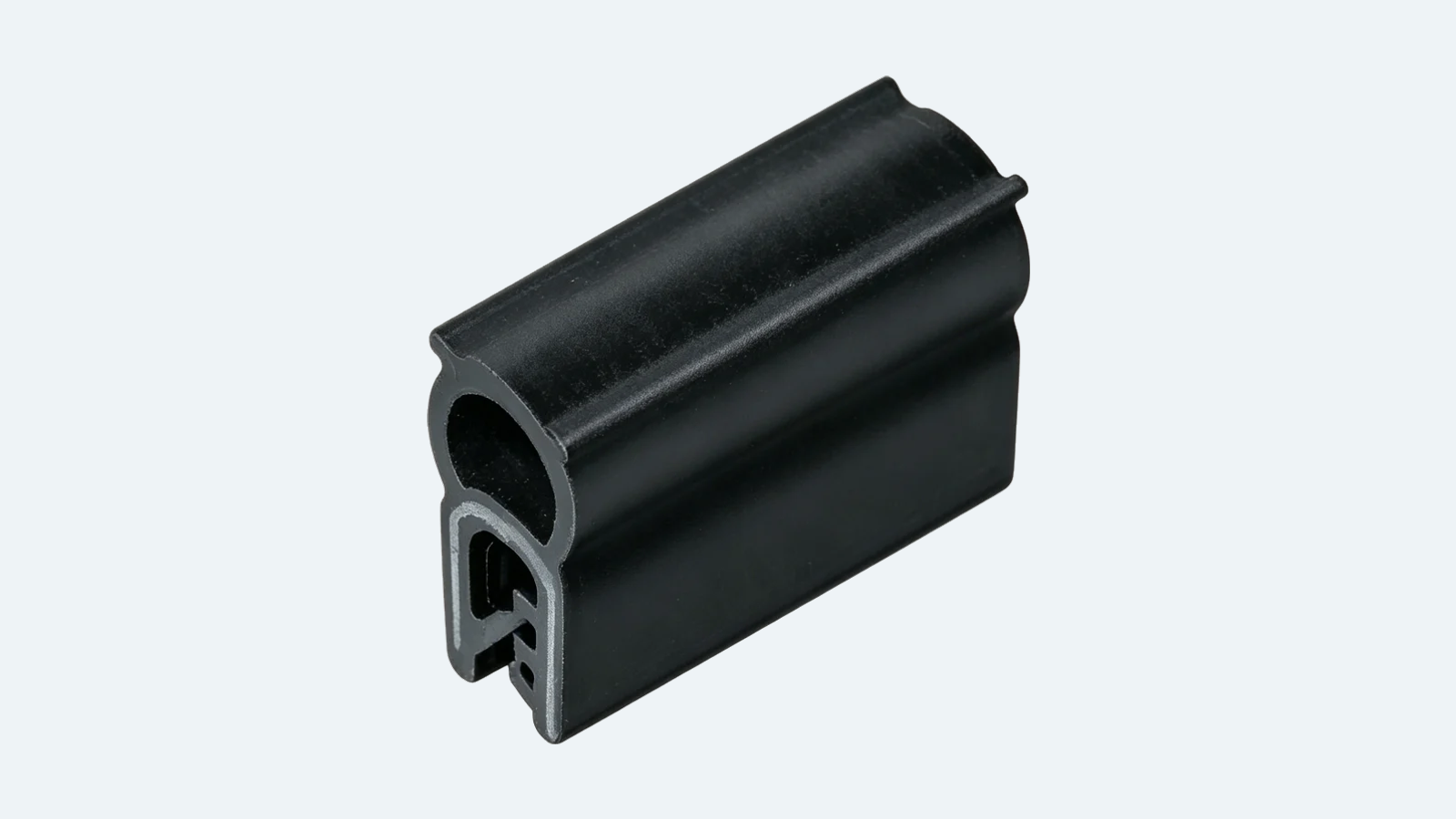
An EPDM sealing strip with a steel carrier is a candidate when the cabinet has an exposed flange that the profile can grip. If the seal sits on a flat land or in a groove, start with a section suited to that mounting surface. The first question is how the cabinet will hold the strip. The second is where the closing door will touch it. On the MFT-001 steel-carrier sealing profile, the section drawing identifies the gripping channel and the bulb that meets the door.
When a quotation uses the term rubber edge trim seal, ask for the cross-section and the identity of the carrier. Two suppliers can use that description for sections with different gripping channels. Mark the edge thickness and the bulb position on your door section. Jump to buyer FAQs / Product pages and sources.
Read the two halves of a steel-carrier seal
On INMAX MFT-001, the lower U-shaped channel wraps around the sheet edge. The section drawing labels the reinforcement “Steel Strip” and shows internal gripping lips. Above it sits a hollow bulb. When the flange holds the lower channel in place, the opposing door face can press on the bulb as it closes. View the MFT-001 section drawing.

The drawing lists two edge ranges, “(1)=1–3.5” and “(2)=3–5”. If your edge falls near their overlap, identify the option on the order and confirm its unit and fit with the supplier. Measure across the finished edge where the gripping lips actually sit, including the coating and any doubled sheet metal in that location. A measurement taken in the middle of a flat panel can miss a folded return.
What changes with a sponge strip?
The MFT-018 product record describes a black EPDM sponge strip. Its section has a narrow stem and a rounded head. The MFT-018 drawing shows the stem and head widths and locates the head centreline above the base. It shows a different mounting shape from the channel on MFT-001. Confirm how the stem will be retained in your assembly and whether the quoted supply includes a backing or fixing.
On a cabinet drawing, mark the mounting surface and trace the outline of the closed door over the rubber section. This makes an offset contact face visible. A taller bulb changes contact at the top of the profile. It leaves the underlying flange geometry the same. Record the closed gap at each corner of the door and send the readings with the INMAX MFT-001 section drawing so the supplier can see how the gap varies around your door.
Check the edge before ordering a sample
| What to measure | Where to check it on the cabinet |
|---|---|
| Finished edge thickness | Measure a straight section, a fold or seam, and the tightest return that the strip must follow. Record the minimum and maximum. |
| Room for the channel | Mark how far the profile can seat down the flange. Include nearby welds, fasteners and a return that interrupts the seat. |
| Closed contact line | Mark where the opposing face should touch the bulb or head. Include the hinge side and the latch side if their gaps differ. |
| Corner and joint | Provide a corner photo or section and mark the intended end joint. Ask for the permissible bend radius for the quoted section. |
Fit a short sample to the least uniform part of the actual flange. Look for a channel that seats continuously, a bulb that meets the intended face, and a corner where the strip stays seated as the door opens. Record the sample reference and the limits you checked so purchasing can identify the same section on a repeat order.
How to check a steel-carrier EPDM sealing strip on a sample door
Choose a sample length that covers the least uniform part of the actual flange. Mark the mounting side and the face that should meet the door before fitting it.
- Start on a straight edge. Record the finished flange thickness at the trial location. Check whether the carrier seats to the intended depth along the straight run.
- Follow the fold into a corner. Mark any place where the channel lifts or a weld interrupts the seat. Photograph that location with the strip in place.
- Close and reopen the door. Look for contact on the intended face of the bulb. If the corner lifts when the door opens, record whether the channel moved on the edge or the bulb caught the door.
- Identify the sample to reorder. Keep the section reference, edge option and marked photograph together. For a sponge strip with a stem, record the proposed retention method on its own drawing.
Product pages and technical references
- INMAX product pages
- MFT-001 steel-carrier sealing profile
- MFT-018 sponge-rubber strip
EPDM sealing strip FAQ
Can a steel-carrier strip also have a sponge sealing element?
Yes. The carrier supports the mounting section. The compressible part meets the closing surface. Ask the supplier to identify the material of each part and mark the contact face on the drawing. Compare the INMAX sealing profile sections.
Does the section drawing give the permissible compression?
The MFT-001 sheet shows the free shape and edge options. To set a closed-door gap, request the working deflection or load data for the specified profile and sample it on the door. Include the finished flange range, closed gap and a corner photo when you ask INMAX for a profile sample.
Which dimensions should I compare on a rubber edge trim seal?
Start with finished edge thickness, channel seat depth and the bulb’s position relative to the closed door. Compare these entries for the exact material and section.